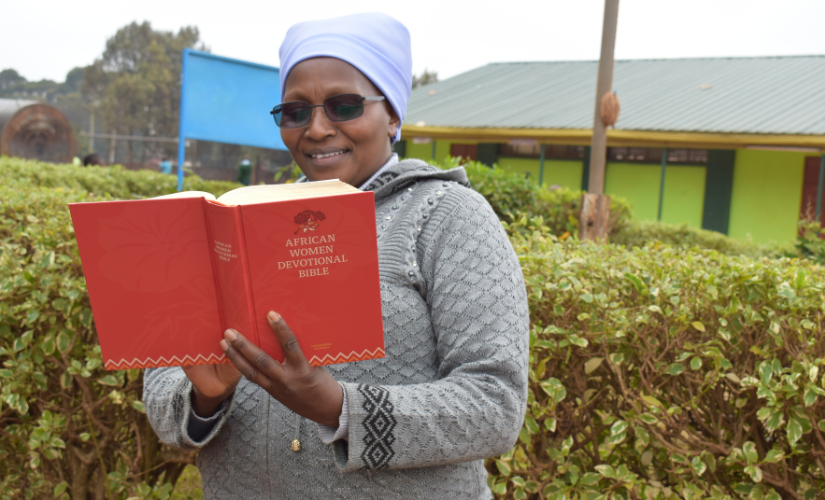

Fact. Reflection on Scripture is the most powerful spiritual practice to help people move forward in their love for God and others.

Proof. The first proof was written more than 2,500 years ago when a Jewish leader penned these words: “I have hidden your word in my heart that I might not sin against you.” (Psalm 119:11)

This leader had overwhelming evidence that taking God’s sacred words to heart would curb sinful attitudes and behaviors.

But it’s 2013. And in today’s world, we — even church leaders — need a fresh reminder of Scripture’s power to transform us.

Over the past five years, several studies have been conducted on Scripture engagement and its potential to strengthen one’s relationship with God. Two stand out. One was conducted in 2008 by Lifeway Research in which 2,500 Protestant Church attendees were followed for a year to determine what helped their faith grow.

Brad J. Wagonner clearly identified the catalyst: The daily discipline of reading. In fact, daily Bible engagement was the No. 1 predictor of spiritual maturation, wrote Wagonner in his book, The Shape of Faith to Come.

Willow Creek Association confirms this finding with its research from the REVEAL survey. Over a period of four years, it polled more than 1,500 churches representing more than 400,000 church attendees at various stages in their spiritual journeys.

Scripture reflection, the REVEAL survey found, is the No. 1 way to help people grow in their love for Christ. “When it comes to spiritual growth, nothing beats the Bible,” wrote Cally Parkinson and Greg Hawkins in their book, Move.

The churches involved in the study ranged in size from under 100 to more than 5,000 and represented all 50 states. They were both denominational and non-denominational and represented a wide range of styles, including contemporary, Pentecostal, Catholic, traditional and mainline.

Parkinson and Hawkins explain that key findings in the REVEAL survey suggest people fall along a spiritual continuum, from exploring Christ to being Christ-centered—and many things advance our walks with God along that continuum.

“But of all the personal spiritual practices—prayer, confession, tithing, journaling, solitude, serving or worship‐we find that one stands out,” Parkinson and Hawkins state. “Scripture reflection—more than any other practice—moves people forward in their love for God and love for others.”


Reflection on Scripture is much more influential than any other spiritual practice by a statistically significant and wide margin, Parkinson and Hawkins state. “For those who would say they are Christ-centered or working to stay close to Christ, Scripture reflection is twice as catalytic as any other factor. This means it has twice the power of any other spiritual practice to accelerate growth in spiritually mature people.”

What’s the implication for church leaders? Quite simply, they need to do more than suggest that congregants read their Bibles regularly. They need to teach that this is a necessity.

“Everything in REVEAL points to the need for us to shake things up—to create a ‘new normal’ for the church—one that doesn’t include people sleep-walking through decades of church attendance as Bibles collect dust in church pews,” Parkinson and Hawkins write in Move.


Can churches that embed the Bible in everything become the norm, rather than the exception? they ask in Move. “Absolutely... but we have learned that a shock to the system may be required. É Current church expectations and standing operating procedures will need to be upended to make it happen.”


American Bible Society believes it is essential that church leaders KNOW the spiritual condition of those they serve. We strongly recommend you consider an assessment of where your attendees are spiritually to establish a baseline of their Bible engagement. For more information on this visit REVEAL.

“If churches could do only one thing to help people at all levels of spiritual maturity grow in their relationship with Christ, their choice is clear. They would inspire, encourage, and equip their people to read the Bible — specifically, to reflect on Scripture for meaning in their lives. The numbers say most churches are missing the mark — because only one out of five congregants reflects on Scripture every day.” (Move, p 19)